
How Digital Simulation is Unlocking Floating Offshore Wind Potential
Floating offshore wind (FOSW) farms are proving to be some of the most challenging projects in the energy and construction sector.
From investor confidence to political headwinds and the sheer logistics of construction, the risks to projects can be significant. But despite these challenges, appetite to get floating offshore wind projects delivered remains strong in many regions, given their huge potential as a source of secure and clean energy. Solutions that help de-risk projects are critical in driving the marketplace for this nascent sector and delivering the projects themselves.
The significant expense of installing FOSW means the industry is installing the largest possible nacelle on each foundation. These components are too large for transportation by road or rail, meaning that for commercial scale FOSW, ports must accommodate these components, requiring an enormous amount of storage space in facilities with a finite footprint and which often depend on high volume throughput.
This is where the challenge lies for ports and why, so far, installations have been relatively small scale and ad hoc based on port availability.
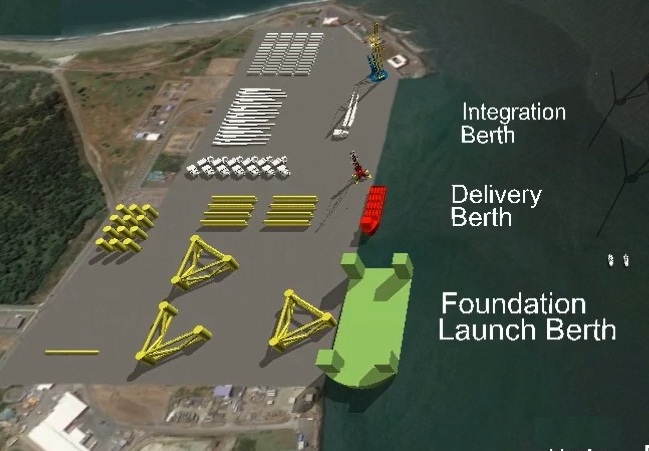
To support the development of commercial-scale FOSW, Moffatt & Nichol has developed a FOSW simulation software specifically to help meet this challenge, through FlexTerm, its dynamic 3D simulation and emulation modeling (digital twin) software.
FlexTerm gives all stakeholders, including the supply chain, the ability to optimise the logistics of the manufacturing, assembly and integration of FOSW components through a robust modelling process.
End users can run an iterative supply chain analysis, identifying project risks and challenges, and make corrections in the virtual space prior to project implementation.
By changing the inputs and variables such as time of year or component type, FlexTerm can simulate proposed operations at a port facility and compare the performance of various scenarios. This software offers both a visual and a report-based analysis, identifying operational pinch points and congestion.
Previously, this was done in a static environment with no ability to dynamically alter inputs and understand the effect on supply chain efficiencies and production outputs.
The new software will model the transit of floating foundation and wind turbine generator (WTG) components throughout the construction process, from manufacturing to assembly port, including load-in to marshalling port, staging and assembly in port, launch from quay into water, and final integration of components at the quay before being moved by tug to wet storage or installation site.
Users can model scenarios using an ‘off the shelf’ version, or put in specific geometries and weights of components, as well as specific launching mechanisms and integration techniques.
There’s a component library built into the software for ease of use, while processes are broken down so different elements of the supply chain can see what’s most relevant to them.
Importantly, FlexTerm includes weather hindcasting, so that users can factor in seasonal risks and select the optimum times for tow to site activity.
The financial modelling section enables identified risks to be paired with project cost implications.
This latest module from FlexTerm is already making an impact, much like its forerunner for bottom fixed offshore wind, which enabled the Port of Esbjerg to triple capacity of OSW throughput through the modelling.
FlexTerm’s FOSW module has now been shortlisted for Software Innovation of the Year at this year’s TechFest awards.
TechFest is run by Construction News and New Civil Engineer in the UK, and it celebrates the best technology innovations in the engineering and construction industry, and entries are assessed by over 60 industry expert judges.
Good luck to our team at the awards ceremony late this month.